
10 NRI Taxation i

NRI Taxation in India: A Complete Guide for Non-Resident Indians

Introduction

Managing taxes can become complicated when you earn income across different countries. For Non-Resident Indians (NRIs), understanding Indian tax laws is essential to remain compliant while avoiding unnecessary tax liabilities. Your residential status, nature of income, and applicable tax provisions determine how your income is taxed in India.

Whether you earn rental income, receive interest from Indian bank accounts, sell property, or make investments in India, understanding NRI taxation helps you plan your finances more effectively and avoid legal complications.


Understanding Your Residential Status

Tax liability in India is primarily determined by your residential status under the Income-tax Act rather than your citizenship. A person may be an Indian citizen but still qualify as a Non-Resident Indian for tax purposes based on the number of days spent in India during a financial year.

Since tax rules differ for residents and NRIs, determining the correct residential status is the first and most important step before filing an Income Tax Return.


Income That is Taxable in India

NRIs are generally taxed on income that is received in India or accrues from sources located in India. Common examples include salary received for services rendered in India, rental income from property situated in India, capital gains from the sale of Indian assets, interest earned on certain bank accounts, dividends, and business income generated within India.

Income earned outside India is generally not taxable in India for NRIs, subject to the applicable provisions of the Income-tax Act.


Tax on Rental Income

Many NRIs continue to own residential or commercial properties in India after moving abroad. Rental income earned from these properties is taxable in India. Property owners are required to report this income while filing their Income Tax Return and may also claim eligible deductions as permitted under tax laws.

Proper documentation and timely tax compliance help avoid future disputes with tax authorities.


Tax on Sale of Property

When an NRI sells immovable property located in India, capital gains tax may become applicable depending on the nature and holding period of the property. Buyers may also be required to deduct tax before making payment to the seller.

Since property transactions involve multiple tax implications, professional guidance is highly recommended to ensure accurate tax calculation and compliance.


Investment Income for NRIs

Many NRIs invest in fixed deposits, mutual funds, shares, government securities, and other financial instruments in India. The tax treatment of investment income depends on the type of investment and applicable tax provisions.

Proper investment planning helps optimize tax efficiency while ensuring full compliance with Indian tax regulations.


Double Taxation Relief

NRIs often face situations where the same income may become taxable in both India and their country of residence. To reduce this burden, India has entered into Double Taxation Avoidance Agreements (DTAA) with several countries.

Understanding the applicable DTAA provisions can help eligible taxpayers avoid double taxation and claim available tax relief.


Filing Income Tax Returns as an NRI

Even if tax has already been deducted at source, filing an Income Tax Return may still be beneficial or necessary depending on the nature and amount of income earned in India. Filing an ITR helps claim tax refunds, report capital gains, maintain financial records, and comply with Indian tax laws.

Maintaining accurate records of income, investments, tax deductions, and supporting documents simplifies the filing process.


Common Challenges Faced by NRIs

Many NRIs face challenges while understanding changing tax laws, calculating capital gains, claiming DTAA benefits, handling TDS deductions, or reporting multiple sources of income. Lack of awareness often results in delayed compliance or unnecessary tax payments.

Professional advice can help avoid these issues while ensuring complete compliance.


How Professional Tax Advisory Helps

Professional tax advisors assist NRIs with tax planning, Income Tax Return filing, DTAA benefits, property taxation, capital gains calculations, tax refunds, and compliance with Indian tax regulations. They also help ensure that all financial transactions are reported accurately and efficiently.


Conclusion

NRI taxation involves unique rules that differ significantly from those applicable to resident taxpayers. Understanding residential status, taxable income, investment taxation, and available tax benefits is essential for maintaining compliance and protecting your financial interests. With proper planning and professional guidance, NRIs can manage their Indian tax obligations confidently while making informed financial decisions.

11

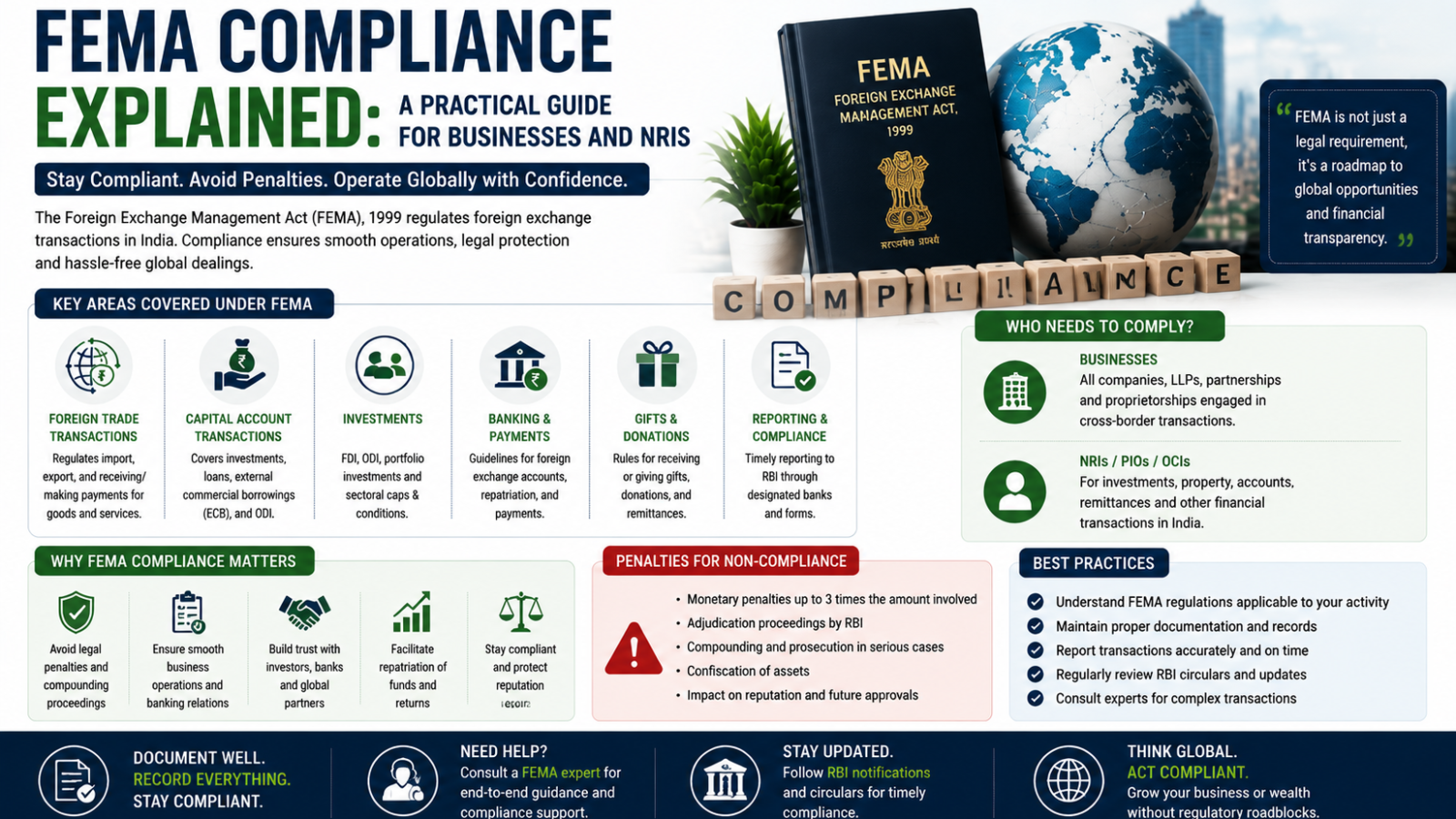
FEMA Compliance Explained: A Practical Guide for Businesses and NRIs

Introduction

Cross-border financial transactions have become increasingly common as businesses expand internationally and more Indians live and work abroad. To regulate foreign exchange transactions and maintain economic stability, India follows the Foreign Exchange Management Act (FEMA). Understanding FEMA regulations is essential for businesses, investors, and Non-Resident Indians (NRIs) involved in foreign investments, overseas transactions, or international business activities.

Proper FEMA compliance helps avoid legal issues while ensuring smooth cross-border financial operations.


Understanding FEMA

The Foreign Exchange Management Act (FEMA) provides the legal framework for managing foreign exchange transactions in India. It regulates transactions involving foreign currency, overseas investments, international remittances, foreign assets, and dealings between residents and non-residents.

The primary objective of FEMA is to facilitate international trade while ensuring proper management of foreign exchange resources.


Why FEMA Compliance is Important

Every cross-border transaction is governed by specific FEMA regulations. Failure to comply with these rules may result in regulatory scrutiny, financial penalties, or delays in obtaining necessary approvals. Businesses engaged in foreign investment, import-export activities, overseas borrowing, or international collaborations should understand the applicable FEMA provisions before entering into any transaction.

Proper compliance also improves business credibility with banks, investors, and regulatory authorities.


Businesses Covered Under FEMA

FEMA regulations apply to a wide range of businesses and individuals involved in international financial transactions. This includes companies receiving foreign investments, businesses making overseas investments, exporters, importers, startups with foreign shareholders, multinational companies, and NRIs investing or conducting financial activities in India.

Understanding whether FEMA provisions apply to your business is an important step toward regulatory compliance.


Common Transactions Governed by FEMA

Several financial activities fall under FEMA regulations, including foreign direct investment (FDI), overseas direct investment (ODI), external commercial borrowings, import and export payments, acquisition or transfer of foreign assets, remittances, property transactions involving NRIs, and investment in Indian companies by foreign investors.

Each transaction is subject to specific reporting and compliance requirements.


Importance of Proper Documentation

Maintaining complete documentation is one of the key aspects of FEMA compliance. Businesses should preserve investment agreements, foreign remittance records, banking documents, board resolutions, regulatory approvals, financial statements, and transaction records. Proper documentation ensures smooth regulatory reporting and simplifies future audits or inspections.


Risks of Non-Compliance

Failure to comply with FEMA regulations can result in financial penalties, transaction delays, regulatory notices, and reputational risks for businesses. Incorrect reporting, unauthorized foreign transactions, delayed filings, or incomplete documentation are among the common reasons for FEMA-related compliance issues.

Timely compliance helps businesses avoid unnecessary legal complications.


FEMA Compliance for Growing Businesses

As businesses expand globally, FEMA compliance becomes increasingly important. Companies planning to receive foreign investment, establish overseas subsidiaries, collaborate with international partners, or raise funds from foreign investors should develop strong compliance systems from the beginning.

Early planning helps businesses complete transactions efficiently while meeting regulatory expectations.


Role of Professional Advisory Services

FEMA regulations involve technical legal and financial requirements that require careful interpretation. Chartered Accountants and financial advisors assist businesses with FEMA compliance, regulatory reporting, foreign investment structuring, documentation, transaction advisory, and liaison with regulatory authorities. Professional guidance reduces compliance risks while supporting smooth international business operations.


Conclusion

FEMA plays a vital role in regulating India’s foreign exchange transactions and international financial activities. Whether you are an NRI managing investments or a business expanding globally, understanding FEMA compliance is essential for conducting cross-border transactions legally and efficiently. By maintaining proper documentation, following regulatory requirements, and seeking professional guidance, businesses and individuals can confidently manage their international financial activities while remaining fully compliant with Indian regulations.